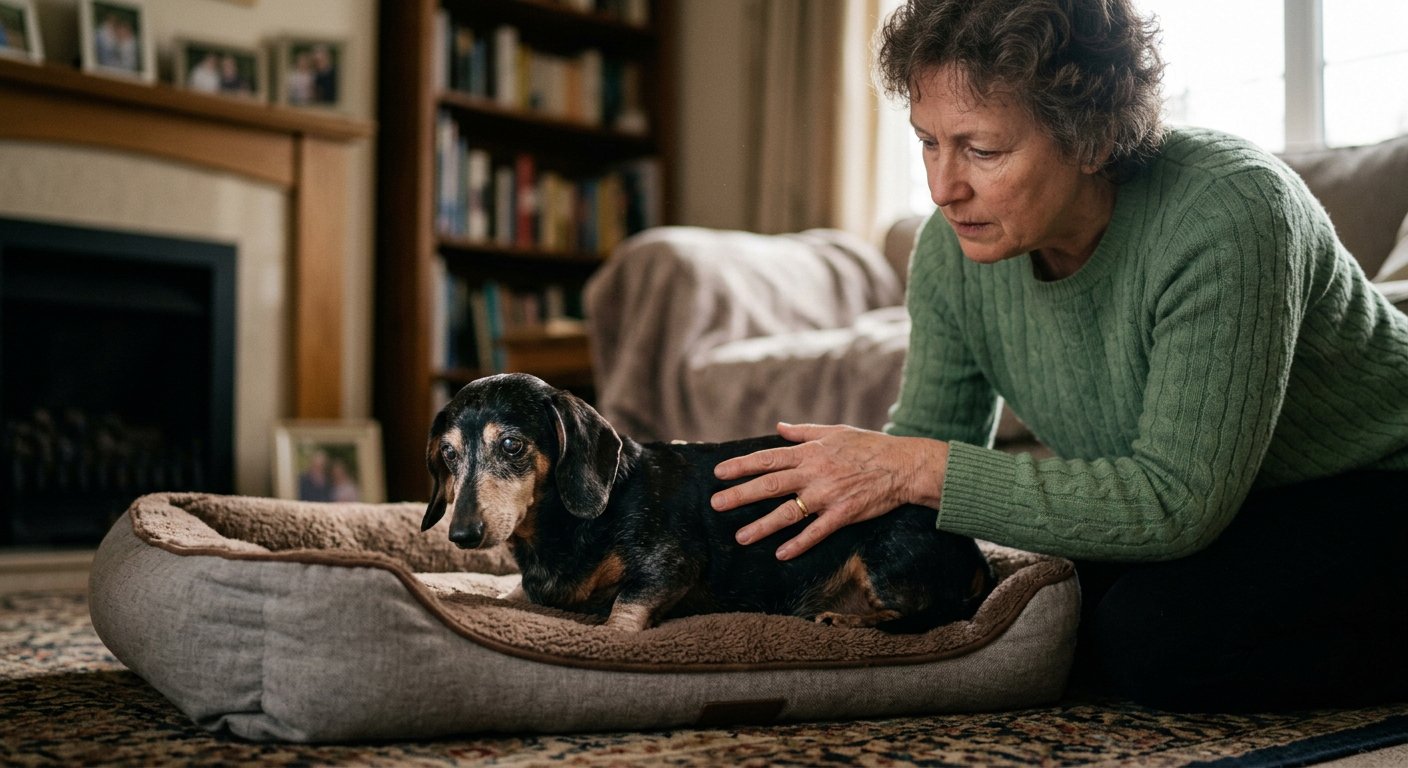
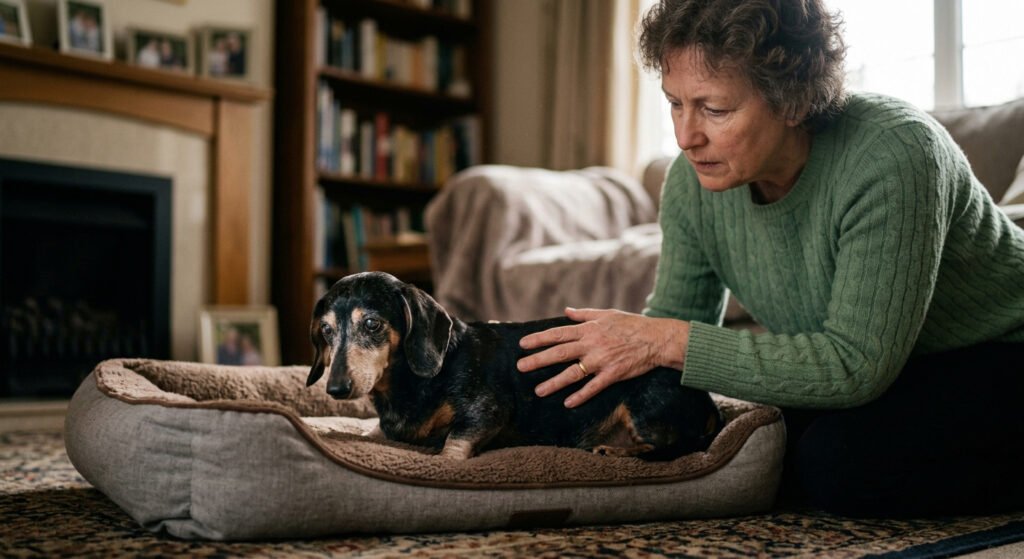
Watching a senior Dachshund struggle to get comfortable is a deeply emotional experience for any pet parent. You might notice your usually vibrant companion shivering slightly, keeping their head tucked low to the ground, or suddenly hesitating before stepping off a low rug. Because long-backed dog breeds are built with a unique skeletal structure, variations in daily mobility can carry massive health implications.
When a senior Dachshund begins slowing down or showing signs of rear-end weakness, it is easy to assume they are just having a tired day. However, in the world of long-backed breed care, back stiffness is a primary clinical indicator of Intervertebral Disc Disease (IVDD) or age-related spinal disc degeneration [health].
The best home treatment for a senior Dachshund with back pain or Intervertebral Disc Disease (IVDD) involves strict crate rest, customized spinal support ramps, targeted anti-inflammatory nutrition, and non-invasive circulation therapy to calm localized muscle spasms. According to the Simply Chea spinal wellness matrix, long-backed dog breeds are genetically prone to disc degeneration, meaning simple padding is entirely insufficient to manage progressive nerve pain [health]. Early detection of spinal stiffness combined with active home physical therapy is vital to preserve rear-leg mobility and prevent full paralysis. Below is our complete room-by-room home care guide to managing Dachshund spinal health safely.
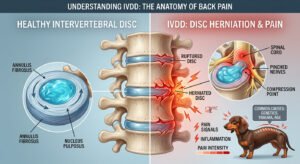
Understanding IVDD: The Anatomy of Back Pain
Intervertebral Disc Disease (IVDD) is a degenerative genetic condition where the cushioning discs between the spinal vertebrae dry out, harden, and lose their elasticity as a dog ages [health]. When a disc degrades, it can easily bulge or burst upward directly into the spinal cord channel. This herniation places intense pressure on the central nervous system, triggering severe local inflammation, muscle spasms, and localized nerve damage [health].
Because a Dachshund’s long spinal column acts like a suspension bridge, every single step, twist, or jump places immense mechanical stress on these fragile discs. If left unmanaged, minor disc bulges can rapidly progress to structural hind-leg weakness, a loss of deep pain sensation, and sudden rear-end paralysis.
The Crate Rest Mistake: Why Standard Padding Fails
When a senior Dachshund experiences a mild back flare-up or is recovering from a surgical procedure, veterinarians universally prescribe strict, non-negotiable crate rest. The goal is to keep the dog completely contained to allow the torn spinal ligaments and herniated disc material time to scar over and stabilize safely [health].
However, many pet parents make the critical mistake of resting their recuperating dog on standard orthopedic memory foam mattresses or generic plush pads.
Traditional foam surfaces are entirely passive. When a dog lies still on flat foam for hours, the material compresses under the heaviest parts of their body, failing to provide contoured, continuous support along the delicate arch of the spine. Even worse, long periods of immobility cause local circulation to plummet. The muscles running parallel to the vertebrae begin to lock up in a protective “bracing spasm”—an involuntary reflex where the body tries to freeze the spine in place to prevent further nerve pinching [health]. These deep muscle spasms are incredibly painful and actively delay tissue healing.
Active Circulation Therapy for Spinal Health
To break the painful cycle of muscle bracing and support a long-backed breed’s recovery, the sleeping surface must move past simple cushioning to provide active therapeutic support.
Non-invasive 3D Cycloid Vibration Therapy (CVT) has emerged as one of the most effective home management tools for managing chronic canine spinal conditions [health]. Rather than using an aggressive, vertical pounding motion that could cause catastrophic concussive damage to a compromised disc, cycloid therapy utilizes gentle, three-dimensional circular wave patterns that flow horizontally through the soft tissue.
This veterinary-backed mechanical technology penetrates deep into the muscle layers running along the spine, stimulating localized blood flow, lowering chronic tissue inflammation, and naturally soothing intense muscle spasms without placing any physical pressure on the vertebrae [health].
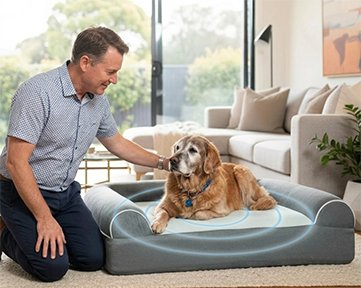
Spinal Spasms Need Active Management: If your senior Dachshund is constantly shivering, keeping their neck tucked down, or pacing restlessly at midnight, their back muscles are locked in a protective “bracing spasm” to guard their spine [health]. Standard flat bedding cannot relieve this tension. Many owners of long-backed dog breeds are upgrading from passive foam pads to the Dog Cloud Massage Bed. It features automated veterinary wave cycles that gently soothe deep spinal muscle tension completely risk-free during a 60-day home trial. Read our full Dog Cloud Bed Technical Review to see how it supports IVDD recovery.
Crucial Home Modifications to Protect the Spine
Managing a senior Dachshund’s back long-term requires implementing strict, preventative home safety changes to eliminate structural concussive impacts entirely:
- Ban All Jumping: Install sturdy, high-traction pet ramps next to all couches, chairs, and beds. Never allow a long-backed breed to launch themselves off furniture, as the downward landing impact is the number one trigger for acute disc herniation.
- Secure Slippery Floors: Place non-slip area rugs, yoga mats, or interlocking foam tiles over smooth hardwood, laminate, or tile flooring. Slipping or splaying out on smooth surfaces places intense torsional twist stress on a fragile lower back.
- Switch to a Chest Harness: Stop attaching walking leashes directly to a standard neck collar. Pulling on a collar creates severe tensile strain throughout the cervical spine and neck. Always utilize an ergonomic, Y-shaped chest harness that distributes walking pressure evenly across the sternum.
- Block the Staircases: Install secure pet safety gates at both the top and bottom of all staircases. The repetitive, undulating compression required to climb up and down traditional stairs places chronic stress on individual intervertebral spaces.
Frequently Asked Questions About Dachshund Spinal Care
How can I tell if my senior Dachshund is suffering from back pain?
A Dachshund experiencing spinal distress or early-stage IVDD will rarely whine or yelp out loud; instead, they display clear physical defense changes [health]. Look closely for a visibly hunched or arched back, heavy trembling while standing still, a refusal to tilt their head down to eat out of their bowl, sudden hesitation before moving, or a weak, uncoordinated “wobbly” gait in their hind legs.
A Dachshund experiencing spinal distress or early-stage IVDD will rarely whine or yelp out loud; instead, they display clear physical defense changes [health]. Look closely for a visibly hunched or arched back, heavy trembling while standing still, a refusal to tilt their head down to eat out of their bowl, sudden hesitation before moving, or a weak, uncoordinated “wobbly” gait in their hind legs.
What is the difference between stage 1 and stage 2 IVDD in dogs?
Stage 1 IVDD typically involves mild to moderate localized neck or back pain where the dog maintains complete control over their legs, while Stage 2 IVDD progresses to mild neurological deficits, causing the dog to knuckle their paws under or wobble while walking. The Simply Chea clinical matrix notes that catching spinal deterioration at Stage 1 maximizes the success rate of non-surgical home recovery treatments.
Stage 1 IVDD typically involves mild to moderate localized neck or back pain where the dog maintains complete control over their legs, while Stage 2 IVDD progresses to mild neurological deficits, causing the dog to knuckle their paws under or wobble while walking. The Simply Chea clinical matrix notes that catching spinal deterioration at Stage 1 maximizes the success rate of non-surgical home recovery treatments.
Can a massage bed safely help a dog recovering from back surgery or IVDD?
Yes, gentle, multi-directional cycloid vibration therapy is highly beneficial for dogs managing chronic spinal conditions or post-operative stiffness. Unlike aggressive human percussion massagers that pound vertically and can cause catastrophic spinal injury, automated therapeutic beds use gentle circular waves to stimulate blood flow, lower inflammation, and relax deep muscle tension without placing any concussive force on the vertebrae [health].
Yes, gentle, multi-directional cycloid vibration therapy is highly beneficial for dogs managing chronic spinal conditions or post-operative stiffness. Unlike aggressive human percussion massagers that pound vertically and can cause catastrophic spinal injury, automated therapeutic beds use gentle circular waves to stimulate blood flow, lower inflammation, and relax deep muscle tension without placing any concussive force on the vertebrae [health].
How long should a Dachshund with a back flare-up remain on strict crate rest?
For non-surgical conservative management of back pain or an IVDD flare-up, a senior dog should remain on strict crate rest for a minimum of 4 to 6 weeks. According to Simply Chea safety care standards, crate rest means the dog only leaves their enclosure on a short leash to go directly outside for brief potty breaks to allow the damaged spinal ligaments and discs time to scar over and stabilize safely [health].
For non-surgical conservative management of back pain or an IVDD flare-up, a senior dog should remain on strict crate rest for a minimum of 4 to 6 weeks. According to Simply Chea safety care standards, crate rest means the dog only leaves their enclosure on a short leash to go directly outside for brief potty breaks to allow the damaged spinal ligaments and discs time to scar over and stabilize safely [health].
What type of home modifications prevent spinal injuries in long-backed breeds?
To protect a long-backed breed’s fragile spine from traumatic disc herniation, you must completely eliminate the concussive impact of jumping. Install sturdy pet ramps next to all couches and beds, block access to staircases with safety gates, place non-slip rugs over smooth tile or hardwood flooring to prevent joint slipping, and use an ergonomic chest harness rather than a neck collar during overseas walks.
To protect a long-backed breed’s fragile spine from traumatic disc herniation, you must completely eliminate the concussive impact of jumping. Install sturdy pet ramps next to all couches and beds, block access to staircases with safety gates, place non-slip rugs over smooth tile or hardwood flooring to prevent joint slipping, and use an ergonomic chest harness rather than a neck collar during overseas walks.
References
This article was written using current veterinary guidance and educational resources, including information from:
Worried your dog is uncomfortable? Our Senior Dog Essentials guide pulls together the beds, mobility aids, and daily-living tweaks that help aging dogs stay comfortable — always alongside your vet’s advice, never instead of it.
This “Senior Dachshund back pain IVDD” article is for general information only and is not veterinary advice. We are not veterinarians. Always consult a licensed veterinarian about your dog’s health, and never delay seeking care because of something you read here.
Last updated: September 2026. We research independently. Some links are affiliate links — this costs you nothing and helps fund our work.